

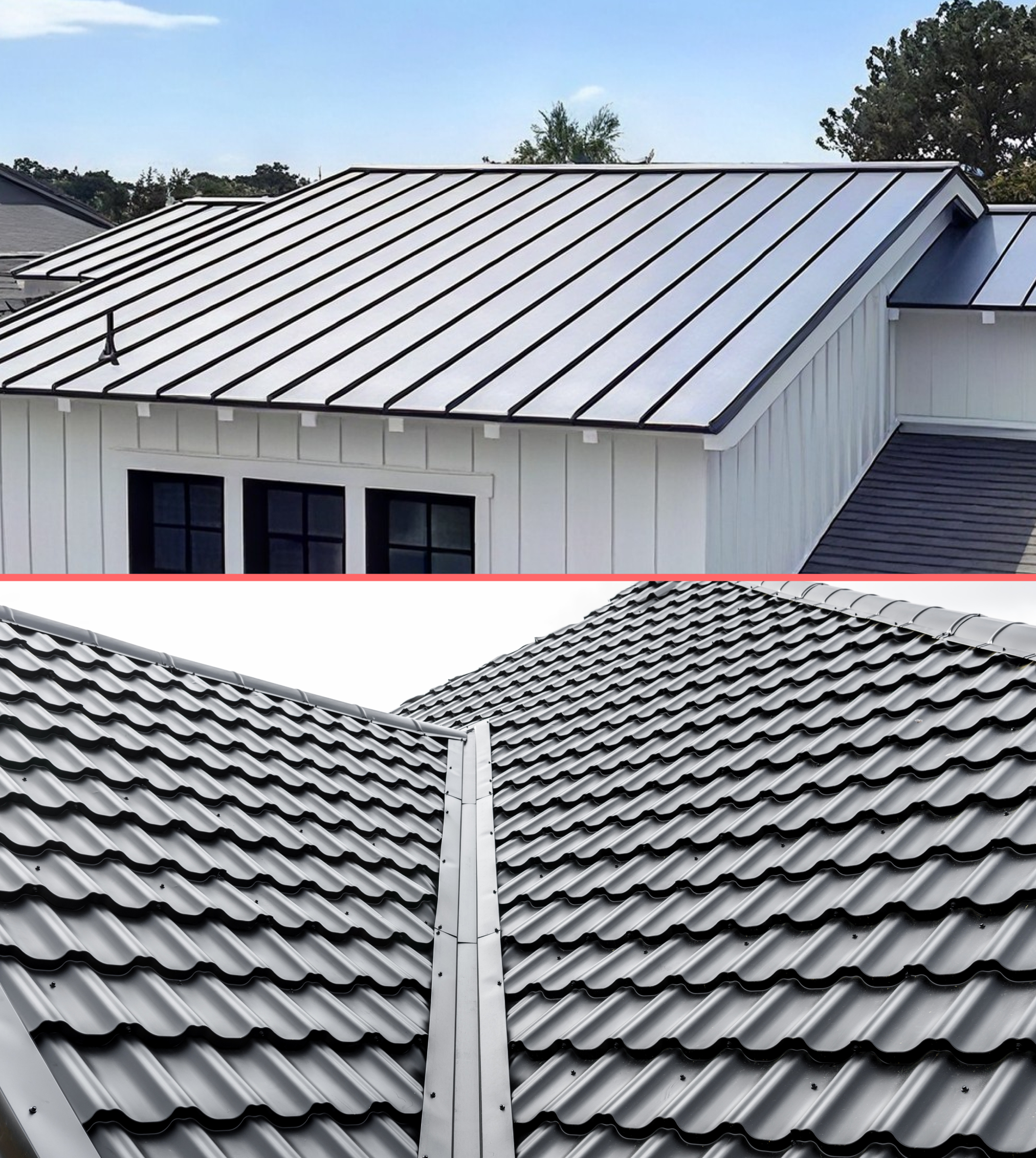
When evaluating a metal roof for your Southern California property, two primary architectural profiles dominate the market: continuous standing seam panels and sectional metal shingles. As San Diego’s architectural sheet-metal specialists, Alpha Metal Systems builds permanent roofing solutions centered on precision-engineered standing seam and exposed-fastener systems.
This guide breaks down the structural differences, lifespans, and performance characteristics of standing seam versus metal shingles so you can choose the ideal roof profile for your home. The decision usually comes down to two factors: which profile fits your roof geometry, and what your HOA’s architectural review board will approve.
Both categories are installed as Class A fire-rated assemblies, the highest fire classification under the California Building Code. In a county where CAL FIRE designates hundreds of thousands of acres as Very High Fire Hazard Severity Zones, that baseline matters before any aesthetic conversation begins.
How Standing Seam Compares to Metal Shingles
The metal shingles vs standing seam decision starts with fastener architecture, because that single difference drives nearly everything else: silhouette, leak risk, slope tolerance, and service life.
Standing seam systems, including Taylor Metal’s Clip-Lock, Versa-Span, and mechanical-lock MS-Series panels installed by Alpha Metal Systems, use continuous vertical metal panels locked together over concealed structural clips. Because all fasteners are hidden beneath the raised interlocking seams, these systems completely eliminate exposed screw penetrations, providing maximum leak protection against driven coastal rain and heavy weather.
Metal shingles take the opposite approach. Stamped from steel or aluminum into a shingle, shake, or tile silhouette, they install as modular sectional units with overlapping joints and exposed or semi-concealed perimeter fasteners. The result reads as traditional from the street while keeping a metal substrate underneath.
| Architectural Feature | Standing Seam Systems (Alpha’s Core Specialty) | Metal Shingles / Stamped Tile |
|---|---|---|
| Primary design | Continuous vertical panels with raised, interlocking seams | Interlocking sectional tiles mimicking slate, shake, or tile |
| Fastener system | 100% concealed fasteners, zero exposed roof screws | Exposed or semi-concealed joint fasteners |
| System offerings | Clip-Lock, Versa-Span, MS-Series (Taylor Metal Products) | Third-party stamped modular panels |
| Visual profile | Vertical, flat-plane, modern | Traditional shingle or tile silhouette |
| Fire rating | Class A fire-rated assembly | Class A fire-rated assembly |
| Leak risk profile | Lowest, with no exterior penetrations and floating clip expansion | Moderate, since fasteners and washer gaskets require periodic checks |
| Substrate options | Galvalume steel, aluminum, copper, zinc | Steel or aluminum, stone coated or painted |
| Slope tolerance | Down to 2:12 with Versa-Span, 0.5:12 with MS-Series | Steeper pitches, where a shingle silhouette is the traditional expectation |
| Ideal application | Coastal homes, low-slope roofs, modern architecture | Steep-slope traditional homes requiring a tile or shake aesthetic |
Panel substrate and finish matter as much as profile. Alpha specifies Kynar 500 PVDF and NexGen S.M.P. coatings on standing seam panels precisely because San Diego’s combination of high UV load and coastal salt air degrades lesser finishes, and you can review the full range on our materials and types page.
Understanding Metal Shingles and Stamped Profiles
Metal shingles and stamped tile profiles are engineered to mimic traditional slate, wood-shake, or Spanish tile while using aluminum or steel substrates. Stone coated steel is the most common variant, bonding natural stone granules in an acrylic base coat over a steel panel.
Where metal shingles are used: Homeowners often explore metal shingles when HOA guidelines require a traditional wood-shake or clay-tile appearance, or when preserving historical architectural detailing. The metal tile vs standing seam question almost always surfaces in exactly these neighborhoods.
The standing seam advantage: While metal shingles rely on overlapping joints and exposed perimeter fasteners, continuous standing seam systems eliminate external screw penetrations entirely. For coastal environments like La Jolla or wind-prone inland valleys, continuous standing seam remains the gold standard for leak prevention and long-term structural integrity.
As San Diego’s architectural sheet metal specialists, Alpha Metal Systems installs precision-engineered standing seam and exposed fastener roof systems. While third-party metal shingles and stone coated steel tiles exist on the market to mimic Spanish tile or wood shake, continuous standing seam remains our core focus for property owners seeking zero exposed fasteners and the highest level of weather protection. You can see how that focus translates across completed projects in our portfolio.
What San Diego HOA Guidelines Actually Allow
San Diego’s architectural review boards are frequently the deciding factor in the standing seam vs. metal tile roof decision, and the rules are stricter than most homeowners expect.
In many of San Diego’s master-planned and gated communities, including those found throughout Fairbanks Ranch, Santaluz, and Rancho Santa Fe, HOA architectural review boards enforce detailed design guidelines to preserve historic Spanish tile, slate, or wood-shake aesthetics. Anyone planning a re-roof in these communities should pull their own covenant documents before selecting a profile, because requirements vary significantly from one association to the next.
Rancho Santa Fe is the clearest published example. The Rancho Santa Fe Association’s Regulatory Code Chapter 49, Exterior Materials, adopted 12.02.21, lists standing-seam and sheet-applied metal roofing under Section 49.0304 as specifically excluded roofing materials within the Covenant. Two-piece clay tile is treated as a defining characteristic of the community under Section 49.0301.
The Covenant does leave a narrow path for shingle-profile products. Section 49.0303 provides that concrete and other Class A simulated shingle and shake type roofing is reviewed and approved by the Art Jury on a case-by-case basis, assessed for color, texture, appearance, and scale. That is a review, not a guarantee, and Protective Covenant Paragraph 155 separately requires that materials be used honestly rather than in imitation of other materials, naming sheet metal directly.
The practical reading for a Covenant property: standing seam is off the table, and a metal shingle or stamped tile profile is a submission the Art Jury may or may not approve. Homeowners outside the Covenant face a very different calculation, which is why profile selection for a residential re-roof should begin with the governing documents rather than the product catalog.
Which Metal Roof Type Lasts Longer
Standing seam outlasts metal shingles, and the reason is mechanical rather than metallurgical. Every fastener driven through a roof panel is a potential path for water over a multi-decade service life, and a concealed-fastener seam keeps those penetrations off the weather-facing surface entirely.
The standing seam vs stone coated steel comparison follows the same logic. Stone coated steel panels are dramatically more durable than asphalt, but their overlapping seams and perimeter fasteners introduce more penetration points across the same roof area, and rubber washer gaskets degrade under sustained UV exposure.
While modular metal shingles and stone coated steel panels offer an extended lifespan compared to traditional 15 to 20 year asphalt shingles, their overlapping seams and perimeter fasteners require periodic washer inspection and maintenance over time. By contrast, Alpha’s standing seam systems, backed by Metal Construction Association data, are engineered to deliver a 40 to 70 year service life with virtually zero ongoing maintenance because all structural clips and fasteners remain 100% concealed from the elements.
Panel gauge also affects real-world performance. The three Taylor Metal standing seam profiles Alpha installs are specified in 24-gauge and 22-gauge, with MS-Series additionally available in aluminum, copper, and zinc for properties facing direct ocean exposure in Coronado, Del Mar, or Encinitas.
Installation quality carries as much weight as profile choice, and this is where the specification stops and the contractor starts. A well-installed metal shingle roof will outlast a poorly installed standing seam roof. Alpha fabricates and installs with full-time, background-screened employees and company-owned roll-forming equipment, with zero subcontracted labor, so the same in-house crew that forms a panel is accountable for how it seams.
How the Two Compare on Cost
Cost on either system is driven by panel customization, roof geometry, and substrate selection rather than a flat difference between profiles.
Standing seam panels are roll-formed to the exact run length a roof plane requires. That eliminates field-splicing and reduces waste, but it also means panel length, seam height, and clip spacing are all specified per project. Metal shingles and stone coated steel arrive as fixed modular units measured in panels per square, which changes the install sequence and labor pattern rather than the underlying material cost.
Roof complexity moves the number further than profile choice does. Valleys, dormers, chimneys, skylights, and every other penetration require custom flashing, and a steep or cut-up roof consumes more labor hours in either system. Substrate choice adds another variable, since aluminum, copper, and zinc carry different material costs than Galvalume steel.
Alpha fabricates standing seam panels in-house rather than sourcing every run from an outside distributor, which controls lead time and lets us match panel length to a specific roof plane instead of working around stock lengths. That capability affects precision and scheduling on standing seam work specifically. It does not change the Class A assembly compliance of either category.
We walk homeowners through these drivers during an on-site assessment rather than quoting over the phone, because roof geometry changes the math more than profile selection does. Our metal roof systems page covers the full installation process and what the assessment includes.
Frequently Asked Questions
Standing seam is the stronger performer for most San Diego properties. Both achieve Class A fire-rated assemblies for wildfire zones, but standing seam’s concealed fasteners remove the corrosion entry points that coastal salt air attacks first, and interlocking seams handle Santa Ana wind loading without exposed screw heads working loose. Metal shingles become the better answer when an HOA requires a traditional tile or shake silhouette.
Yes, though the mounting method differs. Standing seam accepts non-penetrating seam clamps that attach directly to the raised seam, leaving the roof surface completely intact and preserving the panel warranty. Metal shingles generally require penetrating mounts fastened through the panel into the deck, with flashing and sealant at every attachment point. That makes standing seam the simpler substrate for a future solar array.
Key Takeaways
- Standing seam panels use concealed fasteners and floating clips to eliminate exterior penetrations, whereas metal shingles rely on overlapping joints and exposed perimeter fasteners.
- Metal shingles solve an architectural problem by replicating a traditional roofline in steel, while standing seam solves a performance problem by removing every exterior fastener penetration from the roof surface.
- Within the Rancho Santa Fe Covenant, Chapter 49 Section 49.0304 excludes standing-seam and sheet-applied metal roofing outright, while simulated shingle and shake profiles are reviewed case by case by the Art Jury under Section 49.0303.
- Standing seam delivers a 40 to 70 year service life per Metal Construction Association data because every clip and fastener stays concealed, while shingle-profile systems trade some of that longevity for periodic fastener and washer maintenance.
- Panel customization, roof geometry, and substrate selection drive installed cost on both systems far more than the choice between a standing seam and a shingle profile.
Ready to Upgrade to an Investment-Grade Metal Roof?
Whether you are evaluating standing seam for a low-slope modern home or comparing metal options for your coastal property, Alpha Metal Systems delivers precision-fabricated, 100% in-house installed metal roofing across San Diego County. Every assembly is Class A fire-rated, installed by full-time employees, and backed by our workmanship warranty alongside manufacturer coverage on materials and finish.
Alpha Metal Systems. Licensed sheet metal contractor, CSLB C-43-830212. Serving greater San Diego from Oceanside to Imperial Beach.
Testimonials
Need metal roofing or architectural sheet metal solutions? See why homeowners, contractors, and businesses trust Alpha Metal with their most important projects.
Paul Rios
Detailed Estimate, Quality Work, Excellent workers, Professionalism!!! Thank You!!!

Larry Friedman
We have used this company a number of times over the years for gutter issues. They’ve done everything from a complete installation for us to some small repair jobs. We recently had them for their gutter cleaning service. After they were done I used my drone to inspect the gutters and they were completely clean. They are the go-to company for us. They’ve always been responsive, timely, and professional. No hesitation about recommending them.
Peter Toennies
Excellent company. The quality of their work is superb. The entire process from the first meeting to discuss the job, the quote, the coordination of the date and the actual installation were all flawless.
Warren Hair
The installer arrived on time. Worked efficiently. Knew his craft and executed well. Paid attention to the details and did an excellent job. Well done. Thank you
Chad Fuller
I am the Director of Operations for a Roofing and Solar Company. I have used AquaTech’s services for the last ten years. It does not matter whether it is a small garage or a multimillion-dollar project. They have always done exceptional work. I use them on all gutter, aluminum patio, and metal roof projects my company is involved with. Thank you, Andrew and your crews.
Our Service Area
Alpha Metal proudly serves residential and commercial clients across greater San Diego. From La Jolla to San Ysidro and El Cajon, we’re the trusted choice for custom metal roofing and architectural sheet metal projects.
Who We Are
Alpha Metal Systems was built on decades of hands-on experience, a commitment to precision, and a belief that metalwork should elevate a property for generations. Our team blends old-school craftsmanship with state-of-the-art fabrication to deliver metal systems that stand up to California’s climate and stand out for their beauty and performance.
Resources on Metal Roofs & Architectural Sheet Metal
Get insights and advice to help you choose materials, plan, and realize your vision.
Materials & Types
Explore different metal roofing materials and profiles, each selected for durability, style, and superior performance.
FAQs
Find answers to common questions about our metal roofing and architectural sheet metal services.
Portfolio
View our portfolio to see the quality and care Alpha Metal brings to every metal roofing and custom sheet metal project.
Finance the Upgrade You Actually Want
We believe homeowners shouldn’t have to choose between doing a project right and doing it now.
That’s why we’ve partnered with Hearth—so you can move your project forward, without unnecessary financial strain or compromises.
Pre-qualification takes just a few minutes and won’t affect your credit score. Plus, there’s no obligation to move forward unless you find an option that works for you.