

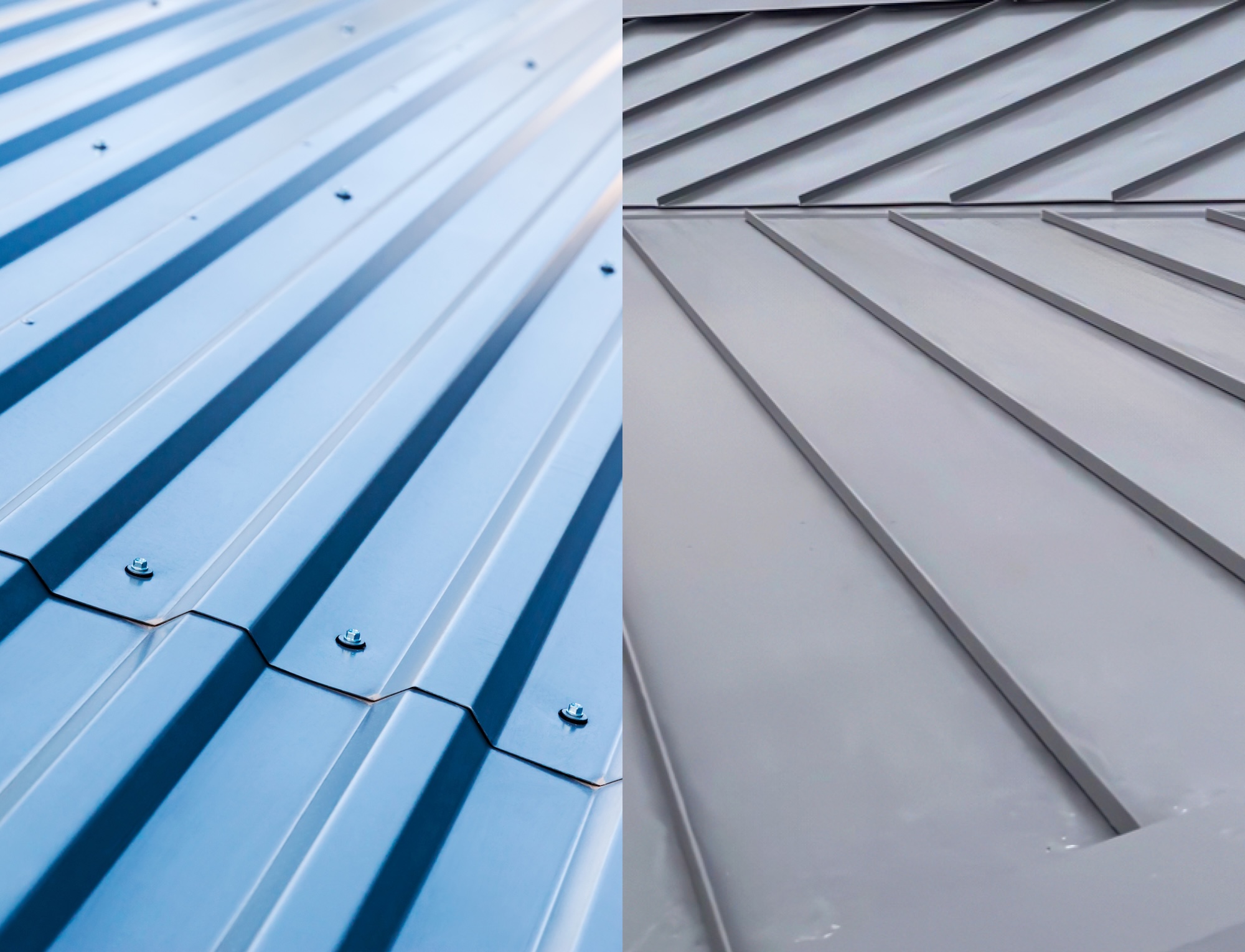
Standing seam and exposed fastener are the two main metal roofing systems, and the difference comes down to how the panels are attached. Standing seam panels interlock through hidden clips, with no screws or nails penetrating the panel face. Exposed fastener panels are screwed directly through the face using neoprene washered screws that stay visible for the life of the roof.
Alpha Metal Roofing installs both systems across San Diego County, and we are not going to pretend one is right for every job. Both sit in our metal roof systems lineup because each one solves a different problem. This guide breaks down the real differences in durability, maintenance, cost, and fit, so you can decide which one belongs on your roof.
Standing Seam Metal Roofing in San Diego covers the full system in depth if you want the broader picture before narrowing in on this comparison.
What Is the Difference Between Standing Seam and Exposed Fastener Metal Roofing?
Standing seam metal roofing uses raised, interlocking seams and concealed clips to attach panels to the roof deck, with no exposed screws and no surface penetrations. Exposed fastener metal roofing, also called screw-down or R-panel roofing, uses exposed screws with neoprene washers driven straight through the panel face into the deck or purlins below.
That single mechanical difference drives almost every other tradeoff between the two systems:
- Concealed fastener systems let panels float on their clips, so the metal can expand and contract with temperature swings without stressing the seam or cracking a sealant joint.
- Exposed fastener systems hold the panel rigid at every screw point, so thermal movement works against the fastener instead of around it.
- Neoprene washers are the service item on any exposed fastener roof. They are rubber, and rubber ages with UV exposure and heat cycling over the years, well before the steel panel itself shows wear.
- Standing seam has no washers in the field. The seam is mechanically locked and sealed at the ridge, hip, and flashing details instead of at hundreds of individual penetration points across the face of the roof.
Hidden fastener and concealed fastener describe the same thing. The Clip-Lock, Versa-Span, and MS-Series profiles we install from Taylor Metal Products all conceal the attachment hardware beneath the seam, and that is the structural distinction between a standing seam system and a screw-down panel.
If you are comparing these two systems for a San Diego project, this is the tradeoff you are actually weighing: fewer components and a faster install against zero long-term penetration points and a cleaner profile.
Panel gauge and coating matter too, though they are secondary to the fastening method. Both systems can use the same base metals and the same panel materials and finishes, including Kynar 500 and NexGen S.M.P. What changes is how the panel is held down, and that single variable determines how the roof ages over the next several decades.
Standing Seam vs Exposed Fastener: Side-by-Side Comparison
| Attribute | Standing Seam | Exposed Fastener |
|---|---|---|
| Upfront Cost | Higher: concealed clip system, more labor per square foot to fabricate and seam | Lower: fewer components, faster install |
| Panel Material Lifespan | 50+ years. Galvalume and aluminum substrates resist weathering under the California sun | 50+ years. Same substrate durability, same resistance to warping, cracking, and peeling |
| Practical Maintenance Interval | Zero fastener maintenance. Concealed floating clips stay protected from UV and moisture | Roughly 15-year washer inspection. Exposed neoprene washered screws require periodic checking and resealing |
| Field Penetrations | None. Every fastener is concealed beneath the interlocking seam | Hundreds of screw points driven through the panel face |
| Aesthetics | Clean, continuous panel lines with no visible fasteners | Visible screw heads across the panel face |
| Fire Rating | Class A fire-rated assembly over fire-rated underlayment. Continuous sealed surface with no exposed rubber components | Class A fire-rated assembly over fire-rated underlayment. Exposed washers age under radiant heat |
| Wind Resistance | Strong. The clip system distributes uplift load across the full seam | Adequate. Resistance is concentrated at each screw point |
| Warranty Protection | Dual-layer coverage. Manufacturer warranty on panel substrate and Kynar 500 finish, plus Alpha Metal in-house workmanship warranty | Dual-layer coverage. Manufacturer warranty on panel substrate and finish, plus Alpha Metal in-house workmanship warranty |
| Best Applications | Primary residences, coastal properties, wildfire zones, roofs with multiple penetrations | Detached and secondary structures, outbuildings, workshops, simple gable roofs |
Alpha Metal installs both systems, and this table reflects what we see in the field.
How Do Standing Seam and Exposed Fastener Compare on Durability and Maintenance?
Both systems are built on panel substrates rated for 50 years or more. What separates them is the maintenance cycle: standing seam requires close to zero routine fastener maintenance, while exposed fastener needs a recurring inspection cycle to stay watertight.
Galvalume and aluminum substrates deliver that 50-plus-year material lifespan in either system, and neither will warp, crack, or peel under the California sun. The variable is the neoprene washer. Every exposed fastener screw depends on a rubber washer to seal its penetration, and that washer has a service life shorter than the steel panel around it.
Because Southern California’s intense sun accelerates the aging of exterior rubber components, standard preventative maintenance guidance for exposed fastener roofs calls for inspecting perimeter neoprene washers roughly every 15 years, confirming the seals remain tight against thermal movement. That is normal service planning for a high-UV climate, not a defect in the system. Left unaddressed across decades, washers dry out, shrink, and begin admitting water at the screw holes.
Standing seam removes that failure mode from the equation. There is no washer anywhere in the field of the roof because there is no field penetration. The clips holding the panel sit concealed beneath the seam, shielded from UV and weather, and the panel is free to expand and contract without ever loading a fastener.
Warranty coverage follows the same logic. While commercial standing seam projects sometimes use specialized third-party weathertight warranties, residential and commercial metal roofs are best evaluated on the strength of the underlying structural protection. Because standing seam conceals all fasteners beneath interlocking ribs, it eliminates exterior penetration points and the moisture intrusion path they create. Alpha Metal backs every installation with a dual-layer warranty: manufacturer coverage on panel materials and Kynar 500 finish performance, paired with our in-house craftsmanship warranty covering installation quality and watertight performance.
Execution is the other half of durability. Every Alpha Metal roof is measured, fabricated, and installed by our own in-house crews with zero subcontracted labor, under California sheet metal contractor license C-43-830212. Seam closure and flashing detail are where a metal roof either performs or fails, and a single accountable crew from measurement through final seam is what keeps that work consistent.
There is also a service factor most homeowners do not weigh until something needs attention. Inspecting or resealing washers on an exposed fastener roof means a crew walking the full face of the roof, screw by screw. Standing seam service, when it is needed at all, is almost always localized to a flashing detail or a seam at a penetration rather than the entire panel field.
Which System Costs More, Standing Seam or Exposed Fastener?
Exposed fastener costs less to install. Standing seam costs more upfront and returns that difference through a longer maintenance-free service life.
The install-cost gap exists because standing seam requires a concealed clip system, tighter panel tolerances, and more labor per square to fabricate and seam the panels correctly. Entry-level metal panel materials start around $12.99 per square foot, and total project investment depends on deck preparation, roof pitch, underlayment grade, and the custom flashing we fabricate in-house for each job. Exposed fastener uses simpler panels, fewer components, and a faster install, which is why it lands lower on day one.
Where the calculation shifts is total cost of ownership. A metal roof lasts 50 years or more, outlasting two to three asphalt shingle replacement cycles, so both systems deliver a significantly lower lifetime cost than conventional roofing. Between the two, standing seam removes the recurring washer inspection and resealing cycle from that 50-year window entirely, which is what closes the gap over a long ownership period.
For homeowners planning a full roof, financing options through Hearth spread the investment across a term the roof will comfortably outlast. Pre-qualification takes a few minutes and does not affect your credit score.
Which Is Better for San Diego Homes?
For most San Diego primary residences, we recommend standing seam. For detached and secondary structures, exposed fastener is a sound choice.
Alpha Metal installs and stocks both systems, so the recommendation follows the roof rather than the inventory. Two factors carry the most weight here.
Coastal corrosion risk. Homes in La Jolla, Point Loma, Del Mar, and Coronado contend with salt air that accelerates corrosion at any exposed metal point. Exposed fastener roofs place hundreds of screw heads directly in that corrosion path. Standing seam presents no exposed fasteners for salt air to attack.
On coastal installations, we specify Kynar 500 and NexGen S.M.P. finishes, engineered to hold color and resist chalking and corrosion in a marine environment. Those finishes are available on both systems, and they carry the most weight in the coastal communities we serve where salt exposure is constant rather than seasonal.
Wildfire zone exposure. Both standing seam and exposed fastener achieve a Class A fire-rated assembly when installed over fire-rated underlayment in accordance with local building code, and Alpha Metal builds every roof to that standard. Within that assembly, standing seam offers enhanced long-term fire resilience because its continuous interlocking ribs leave no exposed rubber washers on the roof surface to degrade under intense radiant heat.
Detached structures away from the coast, without the same exposure profile, are where exposed fastener earns its place: simpler install, fewer components, and a service profile that is entirely appropriate for a secondary structure.
We also weigh roof pitch and building use on site. A low-slope addition, or a structure with numerous penetrations for vents and skylights, pushes us toward standing seam regardless of structure type, since every penetration is another opportunity for a screw-down roof to admit water. A simple gable roof on a detached shop with few penetrations is where exposed fastener performs at its best.
Over time, yes. Exposed fastener roofs rely on neoprene washers at every screw penetration, and those washers age faster than the panel around them. Standing seam has no field penetrations, so it does not share that failure point. Both systems stay watertight when maintained on schedule. Only one of them requires a schedule.
Yes. Converting a roof to standing seam requires a complete system replacement rather than installing panels over the existing material. The old roofing comes off down to the structural deck so the decking can be inspected and the engineered clips properly anchored. From there, we apply high-temperature synthetic underlayment and install new precision-formed panels, concealed clips, and custom-fabricated flashings. This full-system approach prevents trapped moisture and preserves both the Class A fire-rated assembly and wind uplift performance. Our guide to repairing or replacing a metal system covers how we assess which one a roof actually needs.
Standard preventative maintenance guidance for high-UV climates calls for inspecting perimeter neoprene washers roughly every 15 years, with resealing or replacement as conditions require. Coastal salt exposure and direct sun can shorten that interval.
For a primary residence, generally yes. The concealed fastener design, the dual-layer warranty, and a 50-plus-year service life with no recurring washer cycle typically outweigh the higher install figure across the ownership period. For a detached structure you do not plan to keep long term, the comparison is closer.
Different panel profiles can be applied to separate architectural features, such as a standing seam main roof paired with an exposed fastener porch or canopy. Mixing profiles on a single continuous roof plane is not recommended. Continuous slopes require uniform seam heights, matching underlayment, and consistent thermal expansion across the plane, and holding to one profile per slope is what delivers clean flashing transitions and reliable water shedding.
Which System Should You Choose?
The decision comes down to what you are roofing and how long you plan to keep it. A primary residence in San Diego, particularly near the coast or in a wildfire zone, is better served by standing seam’s concealed fasteners and continuous sealed surface. A shed, detached garage, or other secondary structure is a legitimate fit for exposed fasteners. If you are still weighing metal against your current roof, our comparison of metal and traditional roofing and cladding is the better place to start.
Alpha Metal Roofing installs both systems and can walk your specific property through this decision in person. Schedule Your Free Estimate and we will tell you honestly which system makes sense for your roof. Licensed sheet metal contractor, CSLB C-43-830212.
Testimonials
Need metal roofing or architectural sheet metal solutions? See why homeowners, contractors, and businesses trust Alpha Metal with their most important projects.
Paul Rios
Detailed Estimate, Quality Work, Excellent workers, Professionalism!!! Thank You!!!

Larry Friedman
We have used this company a number of times over the years for gutter issues. They’ve done everything from a complete installation for us to some small repair jobs. We recently had them for their gutter cleaning service. After they were done I used my drone to inspect the gutters and they were completely clean. They are the go-to company for us. They’ve always been responsive, timely, and professional. No hesitation about recommending them.
Peter Toennies
Excellent company. The quality of their work is superb. The entire process from the first meeting to discuss the job, the quote, the coordination of the date and the actual installation were all flawless.
Warren Hair
The installer arrived on time. Worked efficiently. Knew his craft and executed well. Paid attention to the details and did an excellent job. Well done. Thank you
Chad Fuller
I am the Director of Operations for a Roofing and Solar Company. I have used AquaTech’s services for the last ten years. It does not matter whether it is a small garage or a multimillion-dollar project. They have always done exceptional work. I use them on all gutter, aluminum patio, and metal roof projects my company is involved with. Thank you, Andrew and your crews.
Our Service Area
Alpha Metal proudly serves residential and commercial clients across greater San Diego. From La Jolla to San Ysidro and El Cajon, we’re the trusted choice for custom metal roofing and architectural sheet metal projects.
Who We Are
Alpha Metal Systems was built on decades of hands-on experience, a commitment to precision, and a belief that metalwork should elevate a property for generations. Our team blends old-school craftsmanship with state-of-the-art fabrication to deliver metal systems that stand up to California’s climate and stand out for their beauty and performance.
Resources on Metal Roofs & Architectural Sheet Metal
Get insights and advice to help you choose materials, plan, and realize your vision.
Materials & Types
Explore different metal roofing materials and profiles, each selected for durability, style, and superior performance.
FAQs
Find answers to common questions about our metal roofing and architectural sheet metal services.
Portfolio
View our portfolio to see the quality and care Alpha Metal brings to every metal roofing and custom sheet metal project.
Finance the Upgrade You Actually Want
We believe homeowners shouldn’t have to choose between doing a project right and doing it now.
That’s why we’ve partnered with Hearth—so you can move your project forward, without unnecessary financial strain or compromises.
Pre-qualification takes just a few minutes and won’t affect your credit score. Plus, there’s no obligation to move forward unless you find an option that works for you.